 Business
How ESG Evolved from Brand Image to Business Viability
Dihego Pansini analyzes the shift of social investment from a PR tool to a critical operational factor.
The ESG agenda is no longer just a tool for public relations and brand perception, but a core component of financial and operational sustainability. In an interview on Marketing - The Podcast, Dihego Pansini explains why companies must unify reputation and real-world impact. Discover how private social investment and public accountability are transforming corporate governance.
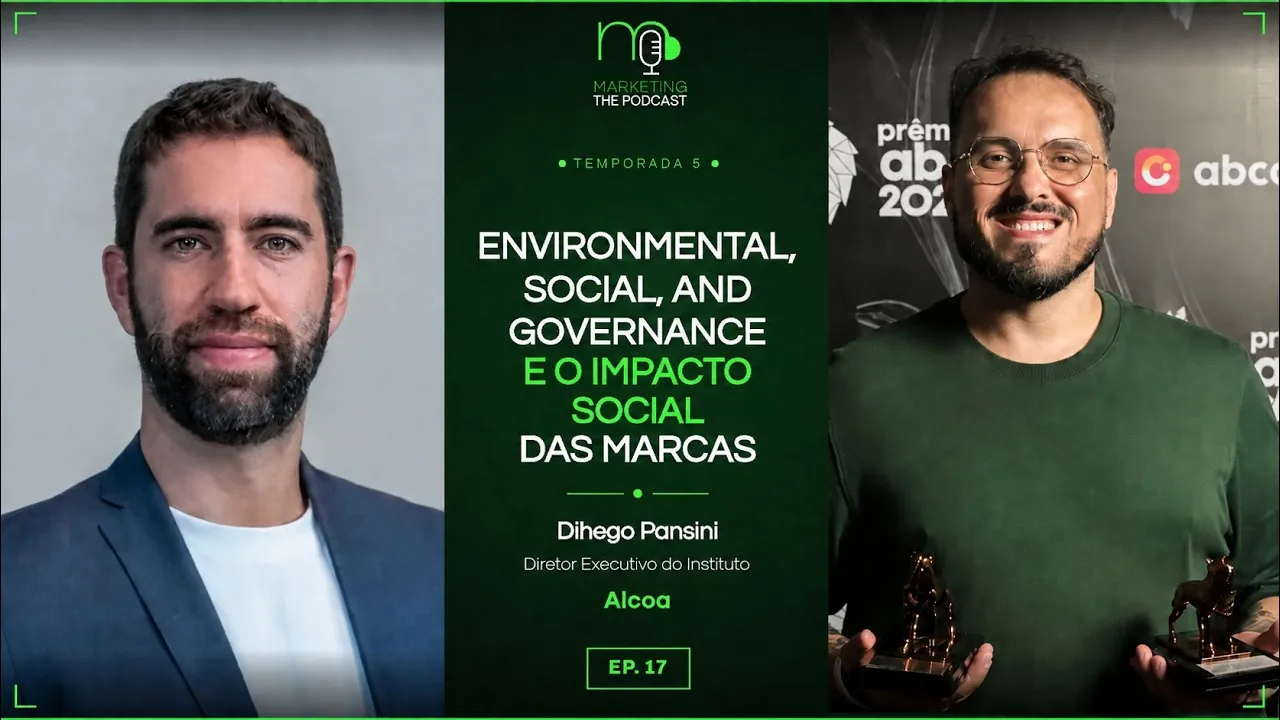
In an interview with Bruno Gimenes on Marketing - The Podcast, economist Dihego Pansini discussed how sustainability and corporate responsibility strategies have shifted from communication add-ons to essential drivers of business survival. The episode covers multiple fronts of social development and corporate governance, highlighting how organizational maturity has evolved when managing impact and brand image.
According to Pansini, the traditional debate pitting brand image against social transformation reflects an outdated market mindset. Mature organizations understand that these two elements do not compete. In the video above, you can watch the full analysis of corporate maturity stages and the practical criteria used to evaluate companies' genuine intentions.
PUBLICIDADE (GAM) — 1250x250
Unifying impact and reputation
When evaluating a company's entry into socio-environmental projects, Pansini highlights that the first step is diagnosing whether leadership still operates under a binary logic or has already moved past it. "I think companies with a high level of maturity today will not look at this topic with any kind of antagonism—in other words, thinking it's either reputation or impact. On the contrary, it's about how to unify these two things," says Pansini.
The volume of resources mobilized by the sector reinforces the importance of this agenda in the Brazilian corporate landscape. According to Pansini, 2024 data shows that private social investment in the country reached nearly 6 billion reais, proving that the topic has moved from the sidelines of financial discussions to achieve large-scale economic significance.
From philanthropy to structural transformation
A historical perspective explains how corporate focus has shifted over time. In the past, social initiatives were almost exclusively tied to one-off sponsorships, charitable actions, and public relations strategies, without requiring metrics for sustained change. "In the past—many years ago—the social aspect was basically viewed as an instrument for image and relationship building," explains Pansini.
In this legacy model, Pansini points out that companies only needed to invest and secure immediate positive perception, without any obligation to drive meaningful community transformation. However, growing socio-environmental complexity, climate crises, and operational shutdowns forced a reassessment of this approach, as neglecting surrounding communities began causing direct financial losses.
The role of social media as an accountability amplifier
The speed of information sharing on digital platforms has reshaped the balance of power between brands and consumers. "Social media has turned into a massive megaphone," notes Pansini when discussing how lapses in posture or inconsistent campaigns trigger immediate crises of confidence.
With audiences becoming increasingly discerning, scrutiny is no longer directed solely at marketing messages, but at production methods and human conditions throughout the supply chain. As Pansini notes, a product's viability now depends directly on the socio-environmental responsibility demonstrated in day-to-day operations.
PUBLICIDADE (GAM) — 1250x250