
B2B vs. B2B2C Dynamics in the Tech Market
Felix Grivot analyzes how company maturity shapes marketing and the role of branding in enterprise sales.
Speaking with Bruno Gimenes on Marketing - The Podcast, Felix Grivot details his journey across various stages of corporate maturity. The marketing executive discusses adapting B2B tech strategies and navigating the convergence of B2B and B2B2C models.
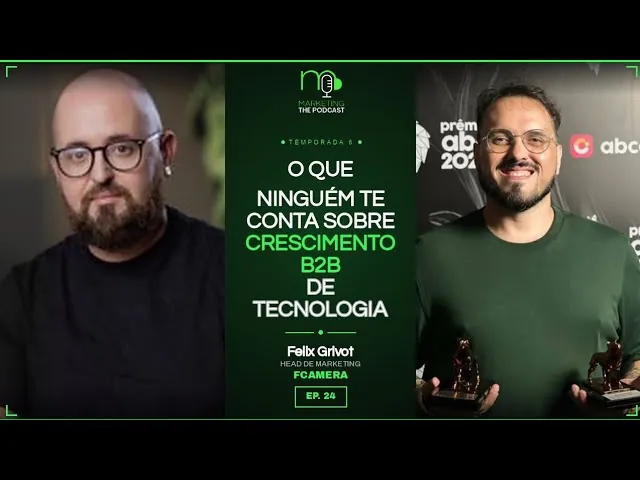
Felix Grivot, Head of Marketing at FCamara, spoke with Bruno Gimenes on Marketing - The Podcast about his career journey across different business stages and the relationship between B2B and B2B2C marketing approaches. While the full episode explores broader topics linking marketing and sales, this excerpt highlights the transition across operating models.
When analyzing FCamara's role, Grivot describes the company's behind-the-scenes presence in corporate digital projects. According to Grivot: "FCamara is a company, a technology and innovation ecosystem—today there are several companies in the group, and what do we deliver to the client? We deliver digital solutions. It's a company with a 19-year track record that started out very strong in e-commerce, placing professionals to develop tech projects, and in recent years expanded its portfolio with other group companies to deliver increasingly comprehensive solutions." In the video above, Grivot illustrates how retail self-service systems and laboratory triage operate on this infrastructure.
Strategy According to Corporate Maturity
Grivot's professional background spans various stages of corporate maturity, ranging from B2C retail at Via Varejo—where he served as Product Marketing Manager for the launch of the digital installment payment plan—to companies focused on B2B technology.
Grivot details how tactical needs evolve depending on capital structure and business stage. At e-Movimento, he experienced the environment of a venture-backed startup, building inbound marketing and lead qualification with SDRs. At Zenvia, he worked in the pre-IPO period focused on developing channels and partnerships. At Pipe Run, the scenario involved a bootstrapped operation focused on predictable revenue, while FCamara required structuring growth followed by dedicated branding efforts.
Regarding this adaptation, Grivot explains: "These different environments allowed me to gain a more complete vision and experiment with different facets of marketing—moving into partner marketing, working as a Product Marketing Manager, and now leading a team. Today, I do a lot of branding work at FCamara, which was an area where I previously had little experience. We structured a lot of growth throughout '23 and '24, and now we're focusing on brand vision, because that is what will take the company to its next stage."
The Connection Between B2B and the End Consumer
When discussing the strict divide between B2B and B2C, Grivot points out that corporate decision-making maintains touchpoints with the end user and relies heavily on building institutional trust. He recalls his experience marketing for a pet grooming equipment manufacturer, where end-consumer acceptance at pet salons drove direct demand back to the manufacturer.
In Grivot's view, the competitive advantage in markets with similar technical services hinges on brand and practical validation: "The difference in my perception, and I think your correlation makes a lot of sense, is that when we are in a pure B2B market, that last mile—that final connection with the end consumer—comes through case studies, social proof, and a strong brand." Grivot adds that while B2B sales are more rational and demand proof of value, the ultimate decision is still made by a person inside the organization.