 Sports
Chinese Running Shoes in Brazil: Challenges and Keep Running
Igor Santos details the inner workings of specialty retail, buying cycles, and the hurdles Chinese brands face in the country.
Igor Santos, founder of Keep Running, analyzes the market landscape for Chinese running shoes in Brazil, along with import and marketing hurdles. The entrepreneur also explains the specialty retail operation and the store's expansion plans.
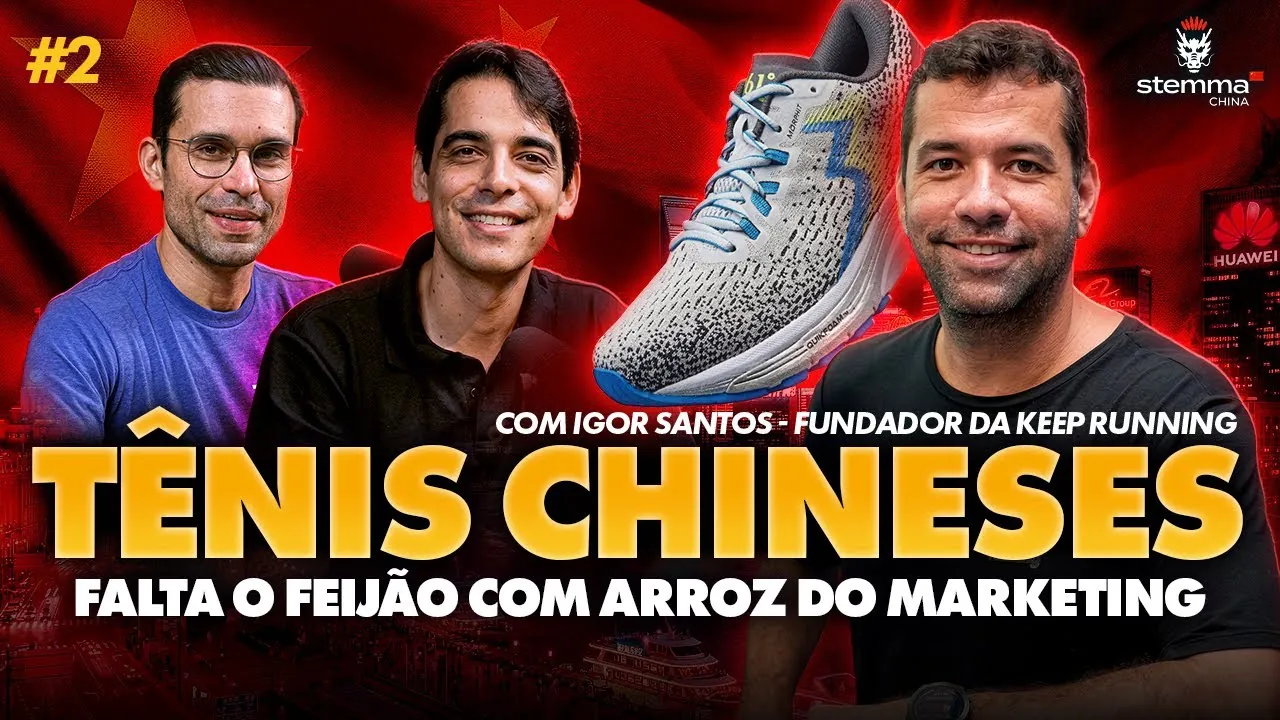
In the second episode of Stemma China, hosts Fabio Bessa and Carlos Gueiros welcome Igor Santos, co-founder of Keep Running. The conversation covers everything from the operational backstage of high-performance running retail to the reasons that still hold Chinese running brands back from mass consolidation in the Brazilian market.
PUBLICIDADE (GAM) — 1250x250
Origin and business model of Keep Running
Keep Running began strictly as an e-commerce operation out of the garage of Igor and his wife, Bel. With the significant surge in high-end performance footwear volume, the company faced a challenge common to digital commerce: price wars and the commoditization of browser tabs. The answer was a shift to a brick-and-mortar space on Sena Madureira in São Paulo, designed as a 360-degree hub for runners that integrates retail, specialized physical therapy with Dr. Anaira, velocity-based strength training (VBT), and content production.
Challenges and perception of Chinese brands in Brazil
Despite evident technological advancements in brands like Anta, Li-Ning, and Xtep—whose top-tier products compete directly with global giants—their expansion into Brazil is hindered by a lack of long-term positioning. Igor recalled Keep Running's experience with 361 Degrees during the Rio 2016 Olympic Games, when supplying uniforms for volunteers failed to translate into consumer demand on the shelves. Runner loyalty to established brands and the heavy burden of import taxes on individual purchases create additional barriers to growth for these manufacturers.
How the running shoe retail buying cycle works
Stocking specialty retail requires planning months in advance. Orders for global releases are finalized semiannually roughly six to seven months before products arrive in Brazilian inventory, while corporate headquarters work on development forecasts up to two years ahead. The case of the Adidas Adizero EVO SL Bob Marley illustrated how storytelling and brand building can overturn initial retailer bets and spark sudden market demand.
Keep Running expansion and brand selection criteria
Keep Running is preparing to open its second brick-and-mortar location in a compact format in Morumbi. Unlike the Sena Madureira concept store, which carries around 15 brands, the new branch will focus on the six highest-turnover manufacturers with the strongest audience connection: Adidas, Nike, Mizuno, ASICS, New Balance, and On Running. This criterion underscores that a brand's viability at the point of sale directly depends on the manufacturer's own investment in storytelling and creating value for the runner.
Trademark disputes and the Qiaodan vs. Michael Jordan case
The episode also explored intellectual property challenges in the Asian market, highlighting the long-running legal battle between Michael Jordan and Chinese manufacturer Qiaodan. Founded in the 2000s using the transliteration of the basketball star's name and a silhouette inspired by the Jumpman, the Chinese company faced years of litigation until surveys showed that 93% of consumers believed it was an officially licensed line.
Keep Running's next steps and the origin of its name
In addition to scaling its physical conditioning services and testing the compact store format, Igor revealed the curious inspiration behind the name Keep Running. The idea came from Johnnie Walker's "Keep Walking" slogan, flipping the visual concept of walking toward running focused on health and athletic progress.
PUBLICIDADE (GAM) — 1250x250