
How Startups and Corporations Drive ROI Through Innovation
Paulo Silveira details acceleration frameworks, AI governance, and the role of communities in venture building.
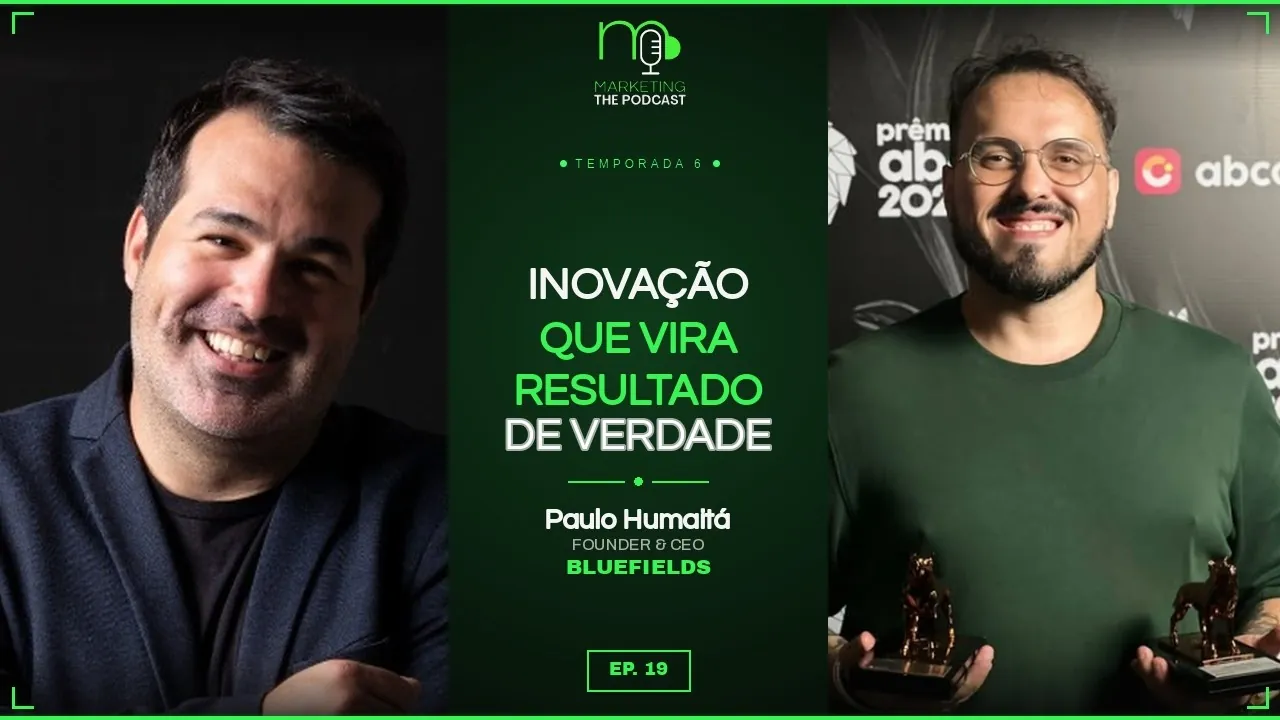
In an interview on Marketing - The Podcast, Paulo Silveira examines how startups and corporations collaborate to deliver measurable innovation ROI. The founder of Bluefields Aceleradora outlines venture acceleration strategies, AI governance frameworks, and impact measurement methods.
Paulo Silveira, founder of Bluefields Aceleradora, spoke with Bruno Gimenes on Marketing - The Podcast about venture acceleration methodologies, cross-functional innovation within corporations, and the practical governance challenges posed by the rise of artificial intelligence.
Throughout the conversation featured in the video above, Silveira shared key insights from his career in open innovation, demonstrated how to validate business models in emerging markets, and outlined a roadmap for organizations looking to execute high-impact 90-day action plans.
Paulo Silveira's Career Trajectory and Personal Pursuits
With nearly two decades in the tech ecosystem, Silveira began his journey during his undergraduate economics studies at UEL, working directly within a technology business incubator. He built a versatile background across biotechnology, agribusiness, and impact businesses, later teaching himself Python during the pandemic to deepen his data science expertise.
Outside the corporate sphere, Silveira is an avid birdwatcher and fiction writer, having published the book O homem que parou de nomear o mundo. "I believe every modern business executive needs to stay restless—it's an essential trait," Silveira argues, emphasizing that continuous curiosity fuels skill acquisition and complex problem-solving.
The Power of Communities in Business Building and Investing
Silveira argues that community building is critical to sustaining and scaling innovative ventures. At Bluefields, this principle is reflected in networks of mentors and investors guided by frameworks such as Redemptive Investing, which pairs financial returns with tangible positive impact.
To illustrate the transformative potential of mission-aligned groups, Silveira points to the Clapham Sect in 18th-century England, a collective that led the abolition of the slave trade in Britain and launched dozens of social initiatives. "People were built to build relationships and create things together, and the resulting impact is exponentially greater," Silveira emphasizes.
Idea Validation, Failure Culture, and Startup Acceleration
When addressing entrepreneurial challenges, Silveira notes that Silicon Valley playbooks do not always translate seamlessly to other markets like Brazil. While American business culture often leans heavily on extensive planning, emerging markets tend to be highly execution-driven, demanding rigorous agile validation to prevent capital waste.
Silveira highlights the case of fintech startup Ciclos, which began by offering payment splitting for non-profit organizations. Following mentorship and targeted audience testing, it pivoted toward the barbershop and salon sector before being acquired by Stone. "There are often multiple great ideas hidden behind a bad one if the founder knows how to stick to the process," Silveira explains.
Corporate Innovation: From Systemic Integration to Practical Steps
According to Silveira, corporate innovation cannot remain isolated within a standalone department; it must integrate across human resources, marketing, logistics, and operations. He stresses that isolated initiatives yield minimal impact compared to cross-functional processes designed around core business challenges.
As practical guidance for organizations aiming to structure innovation initiatives, Silveira recommends starting with an initial diagnostic assessment, followed by 90-day execution plans focused on quick wins. "The real question is: What did you execute, where did you apply it, and what measurable outcome did you deliver?" Silveira emphasizes.
Purpose, Impact Measurement, and the Future of Work
Discussing the intersection of profitability and purpose, Silveira cautions that good intentions must be backed by rigorous impact metrics. He cites Toms Shoes as an example, where the initial one-for-one donation model inadvertently disrupted local economies in recipient regions, illustrating the risks of philanthropic models lacking systemic impact assessment.
Regarding the future of work amid the commoditization of artificial intelligence, Silveira points out that uniquely human skills, such as imagination, will become the primary competitive advantages. "Technology will become ubiquitous, AI will be embedded into every business model and process, and it will commoditize," Silveira observes.
Open Innovation and Transforming Advertising with AI
In media and communications, Silveira describes open innovation models where agencies and enterprise brands deploy white-label acceleration programs to integrate specialized AI agent startups directly into their service offerings.
Silveira also details the Redemptive Futures methodology, which replaces conventional forecasting tools with Futures Back scenario modeling paired with design thinking. "It is far better to be proactive than to simply follow along because everyone else already moved," Silveira underscores.
The Age of Ecosystems, Intrapreneurship, and AI Governance
Modern tooling enables employees across departments to build internal micro-solutions and workflows without extensive coding, giving rise to the "intra-builder." However, Silveira warns that low barrier to entry requires disciplined ideation filters to prevent teams from spending time on projects that never see real adoption.
In this environment, corporate governance and cybersecurity policies become essential to defining which AI models and platforms teams can deploy securely. "The faster companies resolve this, the more technological freedom they grant to the people eager to make a difference internally," Silveira says.
Methodology and Impact Metrics at Bluefields Aceleradora
Silveira shares cumulative results from Bluefields, whose portfolio companies generate over 300 million Brazilian reais in annual revenue and sustain more than 1,000 jobs. The accelerator's methodology boasts an NPS above 80 and CSAT scores nearing 100% across enterprise corporate clients.
Looking ahead, the accelerator plans to scale both its physical and methodological footprint through an international ecosystem. "Our vision through 2040 is to establish Bluefields across 10 strategic hubs, five in Brazil and five abroad," Silveira concludes.