
How Branding Drives Revenue in the Zero-Click Era
Juliana Rosso Frediano explores why paid traffic alone cannot sustain conversions for complex buying decisions.
In a discussion on Marketing - The Podcast, Juliana Rosso Frediano explains how building brand authority directly impacts revenue and buyer decision-making. The conversation covers the limits of paid traffic and the emerging attribution challenges posed by AI search.
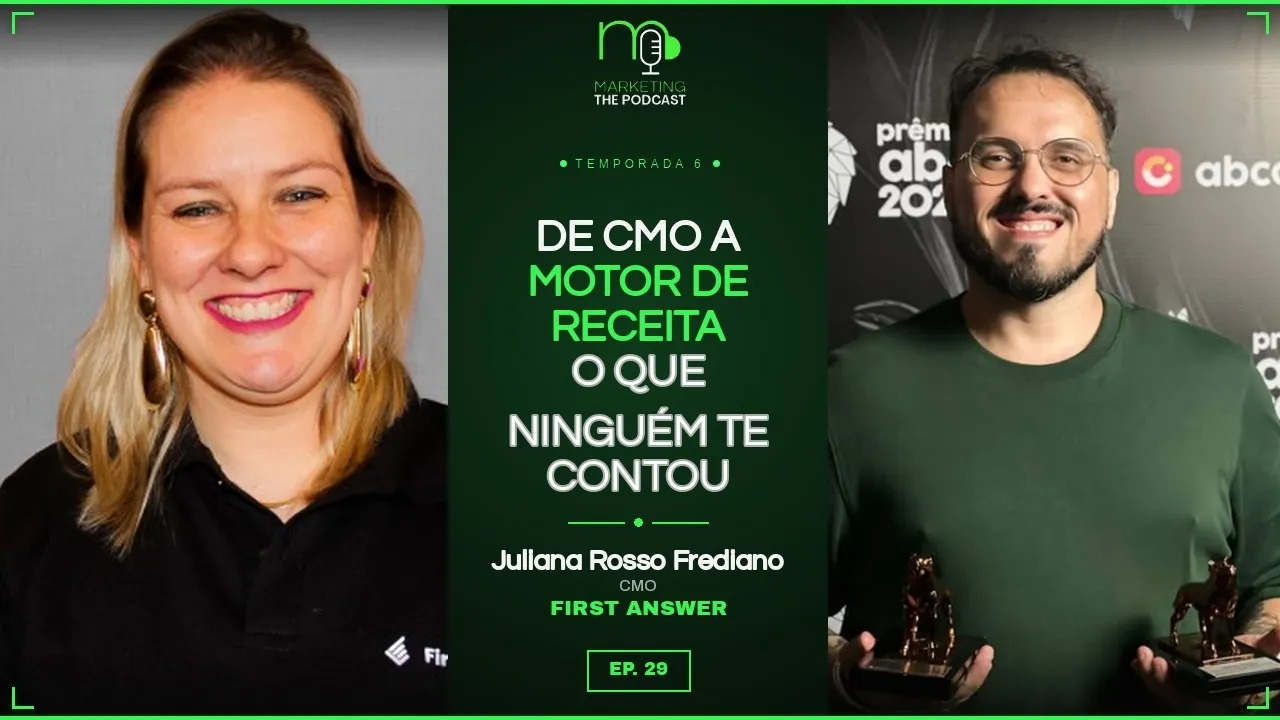
Juliana Rosso Frediano, CMO of First Answer, discussed the impact of branding and corporate reputation on sustaining revenue and shaping enterprise revenue architecture during an appearance on Marketing - The Podcast with Bruno Gimenes. The full episode explores revenue architecture and cross-functional business alignment, examining how brand trust directly influences conversion rates.
In the video above, Frediano and Bruno break down the psychological and commercial mechanics that make brand equity indispensable for businesses seeking sustainable sales growth.
Measuring brand and decision-making
The debate over measuring brand initiatives stems from the difficulty of assigning exact financial value to institutional touchpoints. For Frediano, the commercial justification for investing in brand equity is rooted in buyer psychology and decision-making behavior.
"Would you buy something from a brand you don't know, don't trust, where you see no authority, that lacks a reasonably credible website, or doesn't have social proof showing people used that product or service and liked it?" asks Frediano. She adds: "You answer that—perhaps not with immediate spreadsheet metrics, but through human behavioral data. You look at neuroscience research on how human beings make choices, how our brains help us decide, and that answers the question clearly."
Even with precise product positioning tailored to an ideal customer profile, brands lacking authority consistently lose market share to established competitors offering similar solutions.
AI search and the zero-click era
Shifts in search behavior driven by AI assistants add another layer of complexity to traditional attribution models. Frediano shares a recent purchase experience involving ceramic cookware, where she used Claude to evaluate recommendations and review durability complaints before placing an order.
"Right there, I picked the brand and completed the purchase. But how will that company ever know I bought from them because of my AI research? I never visited their site beforehand," Frediano notes. In her view, conventional journey tracking fails to capture this dynamic: "Ultimately, that brand cannot measure how much brand equity drove the sale. Yet the brand drove 100% of it, because if all those touchpoints hadn't confirmed it was a trustworthy brand, I wouldn't have bought it."
The limits of paid traffic in the buyer journey
Attempting to substitute long-term brand building entirely with paid ads runs into severe economic bottlenecks. Frediano highlights that paid acquisition faces scaling limits and becomes increasingly expensive due to competitive ad auctions.
"Paid media hits a ceiling, and every passing year it inflates. Whether you're spending on major digital platforms or mass media like broadcast television, costs increase by roughly 25% to 30% annually," Frediano explains. She also emphasizes the sheer number of interactions required to close a deal: "Research shows that making a decision can require up to 12 touchpoints along the way."
For high-ticket purchases—such as vehicles priced at $30,000 to $40,000—relying solely on performance media proves insufficient to win over buyers without an established foundation of credibility.
Building long-term recall and authority
Addressing brand penetration across competitive markets, Bruno highlights the trajectory of automakers like Chery and JAC Motors, BYD's high-profile sports sponsorships, and iconic Brazilian advertising slogans such as Tigre's. The cumulative effect of these repeated touchpoints cements brand recall the moment a purchasing need arises.
"It's all about authority. When I need to buy plumbing pipes—an item people rarely purchase—Tigre's market positioning is so strong that it is immediately top of mind," Frediano notes, illustrating how consistent brand presence unlocks future commercial conversions.