Sports
Wanderley Santos on Career and Self-Coaching in Swimming
From starting the sport due to bronchitis to a routine free of self-sabotage, the coach discusses pool discipline.
Experienced coach and swimmer Wanderley Santos shared behind-the-scenes insights into his progression in pool and open-water swimming. He detailed how he built his career from upstate São Paulo and discussed the mindset required to coach oneself without falling into self-sabotage.
Wanderley Santos's journey in swimming began early, driven by a classic childhood reason: treating bronchitis. Born in São José do Rio Preto, in upstate São Paulo, he progressed through the youth ranks as a regular competitor, racing in state and national championships. However, his real technical and competitive breakthrough occurred later, in the masters category after completing his physical education degree.
PUBLICIDADE (GAM) — 1250x250
From personal testing to the masters circuit
After graduating, Wanderley began using himself as a practical laboratory. Without a formal coach, he took full responsibility for his preparation and started testing training methodologies and session structures on his own body, a period during which he achieved his best competitive performances on the masters circuit.
This journey of hands-on experimentation and continuous study allowed him to establish himself as a high-performance coach in São Paulo, in addition to co-leading the Natação Stemma program alongside Samir Barel.
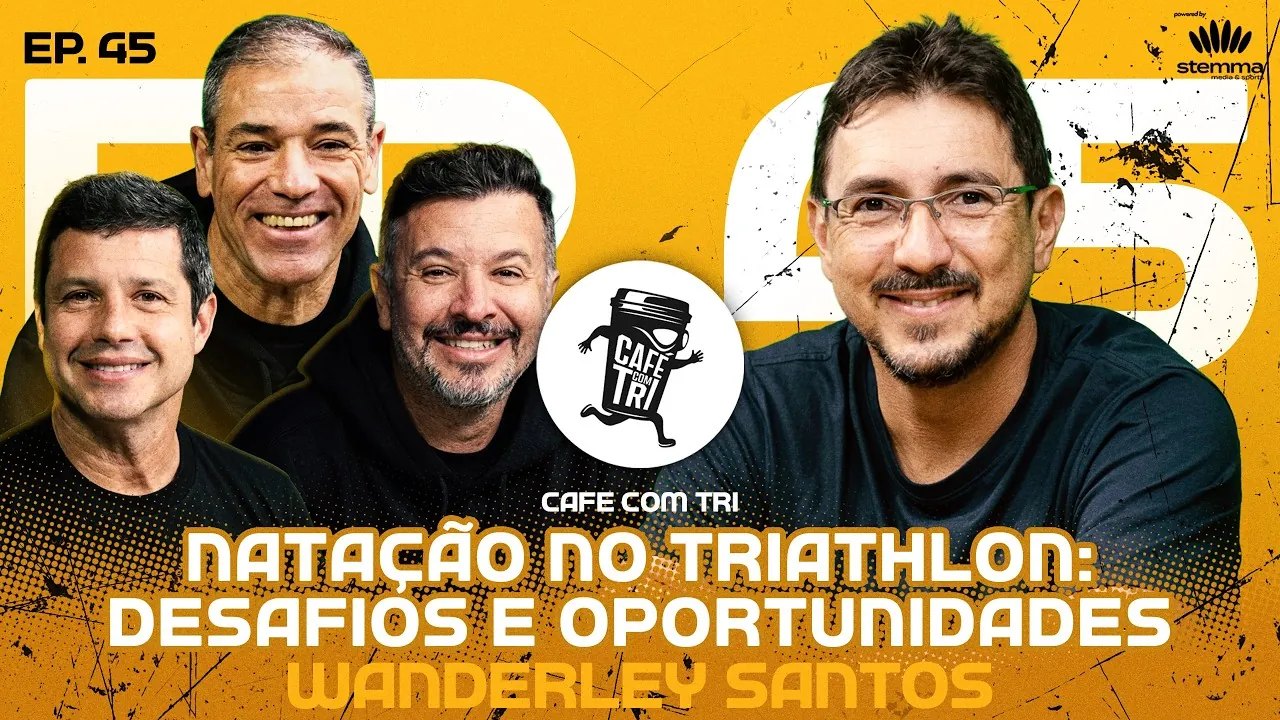
The 10 km experience with Samir Barel
Despite spending years managing his own training schedule, Wanderley recently made an exception to his routine. To prepare for a 10 km open-water race organized by Samir Barel, he entrusted his training to his co-host for four months.
The experience worked well because both share a similar training philosophy: a focus on quality and consistency without relying on astronomical mileage for marathon swimming. The structured program featuring a progressive warm-up, pre-set, and main block ensured Wanderley arrived fully prepared to compete for top positions in the long-distance event.
The challenge of self-coaching and self-sabotage
When asked on the Café com Tri podcast about the difficulty many athletes and coaches face when attempting to self-coach, Wanderley pointed out that the main obstacle almost always lies in self-sabotage. In general, coaches who fail when designing their own workouts end up avoiding the most grueling stimuli or negotiating on intensity.
For him, the key to self-coaching lies in a strict commitment to what needs to be done. Wanderley explained that he often finalizes the exact set combinations while warming up in the water, but never compromises the physiological goal of the day—whether a long aerobic session or an exhaustive VO2 max set, executing the workout with the same rigor he demands from his athletes.
PUBLICIDADE (GAM) — 1250x250