
 Sports
The Rise and History of Chinese Running Shoe Brands
How Fujian manufacturing hubs and bold marketing moves gave rise to giants like Anta, Li-Ning, and Xtep.
China's athletic footwear market has evolved from the world's factory floor into a powerhouse of high-performance global brands. Discover the industrial origins in Fujian, the pivotal role of basketball, and the early days of brands like Anta, Li-Ning, Xtep, and 361 Degrees.
The global athletic footwear and running shoe market is undergoing a profound transformation driven by China. Long seen as the world's primary outsourced manufacturing hub, the country has built homegrown brands that now rival Western giants in innovation, foam technology, carbon plates, and presence in elite sports. Understanding this evolution requires looking back at the industry's early days, defined by the transition from factory floors to global brand-building strategies.
PUBLICIDADE (GAM) — 1250x250
Fujian province and the OEM model
The genesis of most major Chinese brands is centered in Fujian province, particularly in the industrial cities of Jinjiang and Putian, located just across from Taiwan. In the 1980s, when global companies like Nike and Adidas sought to reduce manufacturing costs following price increases in Japan, Taiwan served as the bridge to shift assembly lines to mainland China. This environment fostered a thriving ecosystem of original equipment manufacturers (OEMs), responsible for producing shoes on demand without branding them at the time.
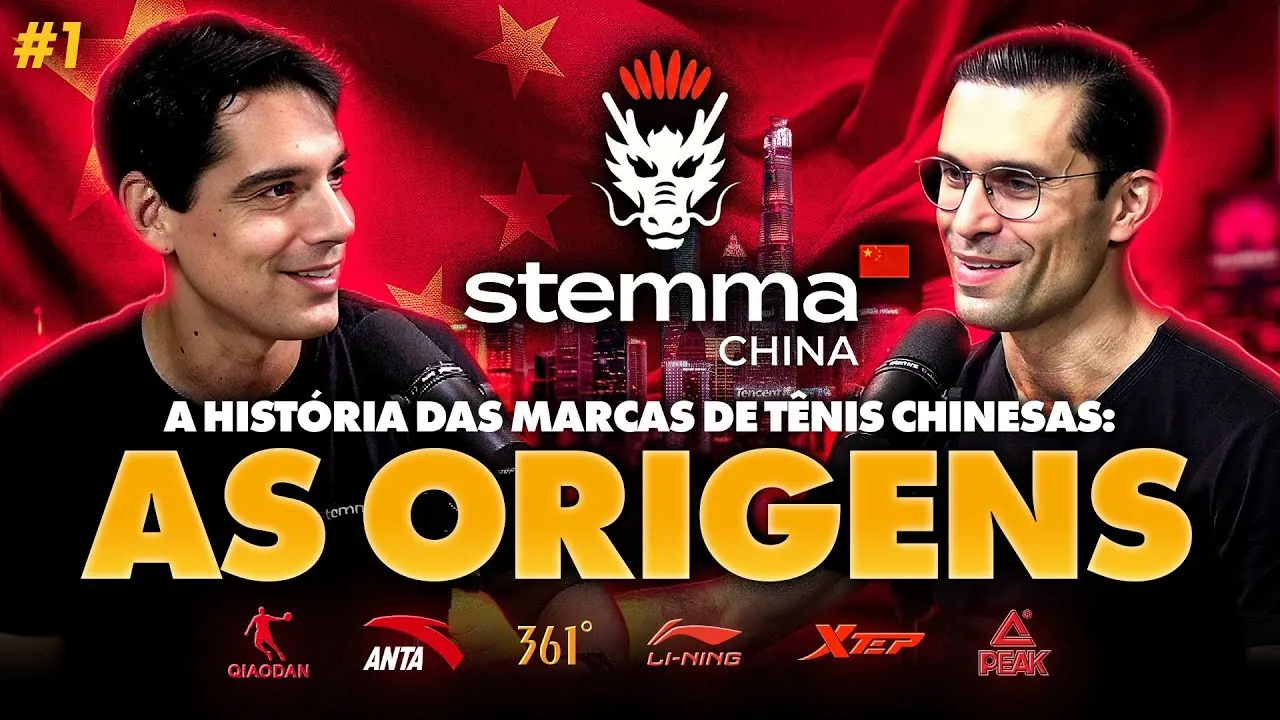
Having mastered the entire manufacturing process and secured raw material supply chains, many local founders realized that true profit margins and commercial value lay in the brand itself, not just the factory floor. This insight led to the creation of brands such as Anta, Xtep, 361 Degrees, Peak, and Qiaodan in the same region, kicking off the transition from anonymous production lines to consumer-facing registered trademarks.
Li-Ning and the pioneering Olympic race
While most manufacturers emerged from Fujian's industrial cluster, Li-Ning was founded in Beijing between 1989 and 1990 by legendary gymnast Li Ning, a gold medalist at the 1984 Los Angeles Olympics. Created with national representation in mind, the brand immediately secured sponsorships for the 1990 Asian Games and the Chinese Olympic Committee for four consecutive cycles, overtaking state-owned Warrior in 1994 to claim leadership of the domestic market.
Aggressive marketing and the turn of the 2000s
Consolidating these brands required bold bets on visibility. In 1999, Anta committed an amount exceeding its entire annual profit to sponsor table tennis player Kong Linghui and run campaigns on Chinese state television (CCTV). The payoff came when Kong won gold and silver at the 2000 Sydney Olympics, propelling the brand to the top of national sales rankings.
Other companies pursued complementary routes to capture public attention. Xtep tapped into pop culture by launching its Fire Shoes in partnership with Hong Kong actor Nicholas Tse, selling more than 1.2 million pairs. Meanwhile, 361 Degrees, formalized in 2003 out of existing manufacturing operations, focused its initial distribution on tier 2 and tier 3 cities, building an extensive retail network across China's interior while Nike and Adidas competed in major metropolitan areas.
The influence of basketball and the road to running
Basketball opened the floodgates for athletic shoe consumption in China. Introduced in the late 19th century by the YMCA and embraced across generations, the sport experienced an unprecedented boom in 2002 when Yao Ming entered the NBA. Although Chinese brands lacked the financial firepower to secure the star over Western competitors, basketball fever accelerated the technical development of high-performance footwear.
The technical expertise accumulated in cushioning and court support laid the groundwork for the Chinese market's later breakthrough into road running. Today, events such as the Shanghai Marathon and the Xiamen Marathon reflect the maturity of an ecosystem that combines manufacturing efficiency, elite athlete sponsorships, and cutting-edge running shoe technology.
PUBLICIDADE (GAM) — 1250x250




