
 Sports
Alexandre Tingas: From Elite Cycling to Sub-2:26 Marathon
Discover the journey of discipline, resilience, and high-volume training that led the former cyclist to become one of Brazil's fastest amateur marathoners.
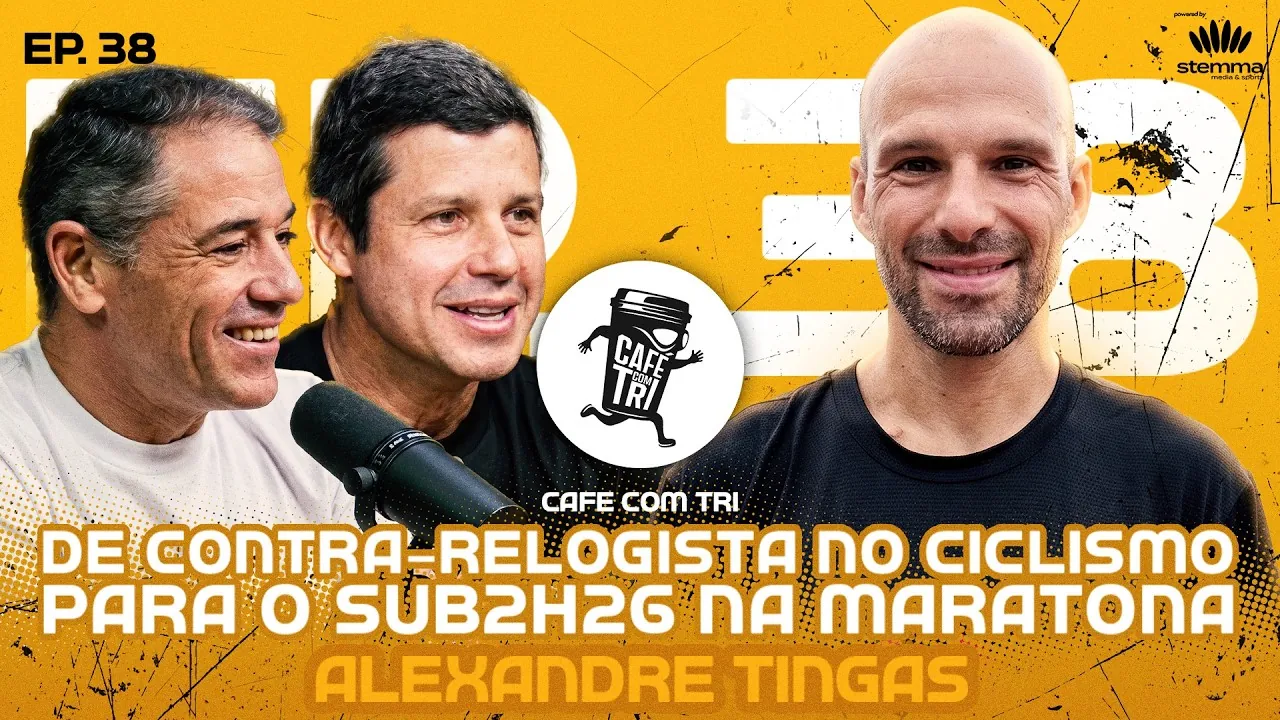
On Café com Tri, we welcome Alexandre Tingas, a former elite cyclist who transitioned to marathons. He shared how he achieved a time of 2:25:52 in Hamburg, securing his spot in the Master World Championships in Tokyo. This is a conversation about training volume, nutrition, and a winning mindset.
Café com Tri. Your dose of triathlon. Grab your coffee and join us!
In today's episode of Café com Tri, hosts Sérgio Magalhães and Beto Nitrini (in the absence of Wagner Spadotto) welcomed Alexandre Tingas, an inspiring figure in the world of endurance. Tingas, a former elite cyclist and now one of Brazil's fastest amateur marathoners, shared his incredible journey. Recently, he clocked an impressive time of 2:25:52 at the Hamburg Marathon, securing his spot for the Master World Championships in Tokyo.
PUBLICIDADE (GAM) — 1250x250
From Bike to Marathon: Alexandre Tingas' Journey
Alexandre Tingas, with over 22 years dedicated to high-performance sports, began his passion for sports with swimming and BMX. After a period of inactivity in adolescence, he returned to training with swimming and running, but soon transitioned to cycling, where he built a career focused on road races and, especially, time trials.
For Tingas, road cycling was fundamental for developing a solid endurance base. He emphasizes the long hours of training and the repetitiveness required by the sport. The transition to speed cycling, even with "speed" bikes, was a natural process, where discipline and a competitive mindset were already rooted. “I can only run what I run today because I built an endurance base over almost 14 years of cycling,” he states.
In 2020, shortly before the pandemic, Tingas decided to focus again on running, initially as a complement. The ease of training during isolation rekindled his passion for running. A VO2 max test at Care Club revealed his high potential for sub-3-hour marathons. The initial desire was just to qualify for Boston, but he soon realized he enjoyed competing against himself. From 2021 onwards, cycling was completely set aside to focus 100% on running, a true "all or nothing" approach.
His strategy for the Hamburg Marathon, under the guidance of coach Rogério Ramos, was based on an extremely high training volume. In 9 months, he accumulated 5,506 km. The specific 6-month cycle had no month with less than 600 km. A typical week included:
- Monday, Wednesday, Friday, and Sunday: Easy runs of at least 20 km.
- Tuesday: Interval training (e.g., USP).
- Thursday: Fartlek.
- Doubles: From Monday to Thursday, he would do a second session of 10 to 12 km in the afternoon, totaling up to 32 km in a day.
- Saturday Long Runs: Included blocks at race pace, simulating marathon intensity.
- Super Wednesday: Weekly (or bi-weekly), 2 to 2.5-hour low-intensity runs, covering 28-30 km, to build even more endurance and volume.
Tingas' nutrition is based on "real food": lean meats, eggs, legumes, vegetables, and white rice. He avoided grains and whole-wheat bread, opting for French bread. For high performance, he cut out sugar and alcohol for long periods, realizing that alcohol is inflammatory and a trigger to derail training. During the Hamburg race, his nutritional strategy involved 88g of carbohydrates per hour, mainly Z2 gels without palatinose, and 1,200mg of sodium, adapting to the climatic conditions.
For recovery, Tingas prioritizes listening to his body, using physical sensation instead of rigidly adhering to pace or heart rate. He performs daily flexibility and mobility exercises, in addition to using ice baths and sauna at Contrast Club, which, according to him, improved his respiratory capacity, heart rate, and heat resistance. The use of varied terrains (grass, dirt) and treadmills in second sessions also contributes to injury prevention.
His mindset was forged by experience. After mistakes in marathons like Boston, Buenos Aires, and Floripa due to gastrointestinal issues, he learned to adapt his nutrition. “In sports, we lose more and make more mistakes than we win or get right, and the magic is in taking the mistake and the bad day and learning from it,” says Tingas. Confidence, without arrogance, and mental work are crucial. “I wanted to be an athlete; I wanted to live as I did in cycling, disciplined.”
Alexandre Tingas' next big goal is the Master World Championships in Tokyo next March, where he aims to further lower his 2:25 time. He recognizes the need for physiological adaptation, seeking to become lighter. Besides the marathon, Tingas emphasizes the importance of maintaining speed over shorter distances, such as 5 km and 10 km, as a foundation for the marathon. He is currently studying Physical Education, with the goal of combining strategy and technical knowledge with his athletic world.
Alexandre Tingas' story is a powerful reminder that passion, combined with discipline and a well-defined strategy, can lead to extraordinary results. His final message is clear: “Love the process. The process teaches more than the journey and the outcome.” Regardless of the numbers, his love for the sport is what keeps him moving, building, and evolving.
You can follow Alexandre Tingas on his Instagram: @alexandre.tingas, and learn about his supporters: Z2 (supplements), Contrast Club (contrast therapy), Coros (watches), and Berberine (longevity supplements).
PUBLICIDADE (GAM) — 1250x250




