
The B2B Sales Delta: Marketing, Process, and Psychology
Daniel Rosa analyzes how human connection and structured methodology sustain complex enterprise sales negotiations.
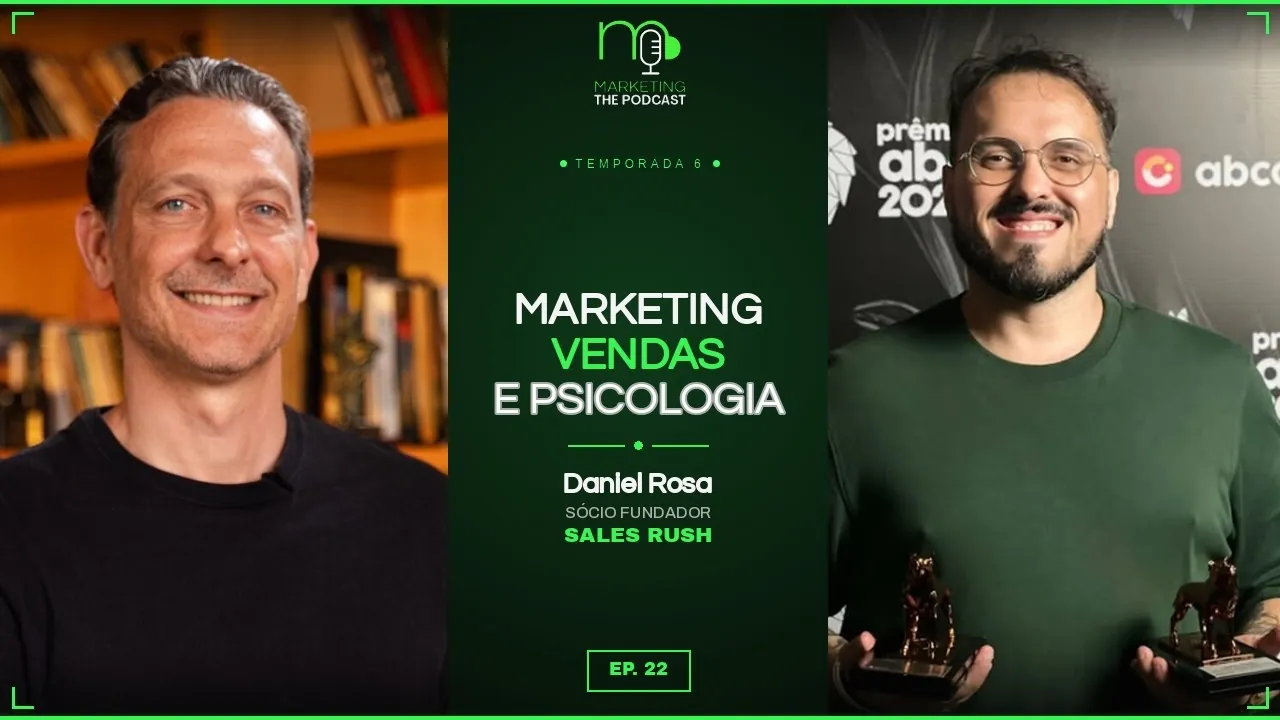
Daniel Rosa, co-founder of Sales Rush, breaks down the B2B sales delta framework on Marketing - The Podcast. The conversation explores why aligning marketing, structured processes, and behavioral psychology yields greater results than working in silos. Key discussion points include ICP definition, brand culture, and creative depth.
Daniel Rosa, co-founder of Sales Rush, joined Bruno Gimenes on Marketing - The Podcast to discuss the integration of marketing strategy, process design, and psychological insights in corporate negotiations. The executive argues that digital acceleration and automation tools cannot replace the human and cultural fundamentals required to close complex deals.
In the video above, Rosa shares his hands-on perspective on aligning sales teams, diagnosing client needs, and reviving critical thinking amid rapid technological shifts.
ESPM Lecture and the Essence of Connection in Sales and Marketing
Rosa shared his recent experience lecturing at ESPM, where he addressed the evolution of media planning and the conceptual distinction between advertising and broader marketing. In his view, advertising represents only a fraction of the discipline, while marketing encompasses the comprehensive study of human behavior and consumer psychology.
The executive emphasizes that emotional connection is the core driver for opening commercial opportunities. Rosa highlights that empathy must precede the sales pitch: "Try to understand what course they are taking, what they are looking to study, what their goal is. That is how you build a connection—you enter a small part of their life before you ever try to sell."
The Entrepreneurial Journey and Learning from Setbacks
Reflecting on major career projects, such as the A12 platform and Ofertas Chevrolet, Rosa emphasizes that crises and operational setbacks are essential to building business maturity.
Rosa asserts that transparency regarding past mistakes builds genuine credibility across the business ecosystem: "The person who takes risks, who fails, who openly says they failed and handles it with composure—that is usually the person who won't deceive you. The one pretending everything is always perfect is the one who will."
Artificial Intelligence and the Need for Cultural Depth
The application of AI tools in content creation and ad campaigns was critically evaluated. Rosa contends that prompting automated systems for creative solutions without a solid technical foundation or cultural background results in shallow, ineffective output.
According to Rosa, professionals must master historical and aesthetic concepts before delegating work to technology: "Build your foundation, read the books, study, grasp the concepts, write summaries by hand, and only then bring it to AI for a different angle—after which you refine it again."
Creative Repertoire, Leisure, and Crafting Memorable Campaigns
The discussion highlighted how life experiences and mental downtime nurture idea generation. Bruno recalled developing a campaign featuring the singer Supla alongside urban activations, illustrating how cultural touchpoints outside the office unlock creative breakthroughs.
Rosa underscores that overfilling schedules with routine tasks eliminates the space needed for creative leisure, impairing professionals' ability to craft original, enduring concepts.
The Attention Economy and Immersing in Urban Culture
In the shift from the information economy to the attention economy, Rosa argues that brands and creatives must step out onto the streets to observe real-world dynamics rather than remaining isolated in corporate offices.
For Rosa, advertising relies on anticipating authentic social behaviors: "From the perspective of an advertiser, a creative, or a marketer, we ultimately sell to human beings. It does no good to sit in an air-conditioned room on Faria Lima inside an armored car and think, 'I understand everything, I went to Harvard.' You have to go out there and understand the local population, how people actually behave today, and what young audiences value."
Sports as a Tool for Social Impact and Branding
The impact of sports in grassroots communities and social initiatives was highlighted as an opportunity for brands to engage public spaces meaningfully. Rosa pointed to educational and training programs designed to prepare young people for the job market.
Rosa notes that exposure to diverse realities deepens market understanding: "That perspective from underserved communities also brings the voice of the everyday consumer, which is invaluable." He adds that established brands have ample opportunity to expand public-private partnerships in urban parks and sports centers.
The Value of Deep Reading and the Classics for Critical Thinking
Reading classic literature and dense works was championed as an antidote to the fragmented consumption of digital media. Rosa likens the analytical rigor of deep reading to physical strength training.
Rosa points out that challenging literature trains the brain to construct coherent reasoning: "When you read denser material, it creates a productive mental friction. It builds a muscle. When you go to the gym and work out, your muscles are sore the next day—it isn't a problem, it's rebuilding stronger."
Basketball Lessons and Teamwork in the Corporate World
Drawing insights from sports literature—such as Phil Jackson's leadership philosophy and Kobe Bryant's development—Bruno and Rosa discussed why collective cohesion consistently outperforms isolated individual talent.
The conversation underscored that reaching corporate milestones and managing sales pipelines depends on seamless alignment across operational and support departments, moving past individualistic attitudes to secure sustainable business outcomes.
The B2B Sales Delta: Integrating Marketing, Process, and Psychology
Explaining the core methodology of the delta framework, Rosa details that marketing uncovers human behavior, sales structures predictable processes, and psychology enables accurate reading of interpersonal dynamics during negotiations.
Rosa explains that rushing high-value enterprise accounts without relational maturity leads to lost deals: "We are talking about strategic B2B sales. This delta revives the idea of looking at marketing through the lens of human behavior first. Sales is the process piece. When you unite them, you control the outcome. And psychology is the ultimate closer."
Practical Psychology, Empathy, and Adaptability in Sales Meetings
Leading meetings with C-level executives requires keen sensitivity to scheduling disruptions and the emotional states of decision-makers. Rosa points out that breaking tension and showing sincere interest in the other party moves stalled deals forward.
Rosa highlights the delicate balance between CRM discipline and situational flexibility: "If someone demands complete order and rigid control, they panic when chaos hits. But if you only rely on improvisation, you lose predictability. You must update the CRM and handle the basics, while avoiding disorganization that prevents long-term growth."
Authentic Relationships and Long-Term Reputation Building
Closing high-ticket deals requires sustained reputation building within industry ecosystems. Rosa and Bruno discussed why treating clients as strategic partners delivers far greater value than transactional selling.
Rosa emphasizes that genuine relationships reduce the pressure for immediate closes: "Especially for enterprise and high-ticket sales, you have to build strategic rapport. A rewarding aspect of this approach is that you genuinely build friendships across the industry."
Sales Diagnosis and Precision in ICP Definition
Reviewing the core pillars of commercial diagnosis—structure, metrics, capabilities, and market—Rosa identifies defining the Ideal Customer Profile (ICP) as the most frequent blind spot for organizations.
Rosa warns against diluting focus across overly broad markets: "There is a common impulse to sell a little bit of everything to everyone, which undermines growth because selling to everyone means selling to no one. You are far better off targeting a precise ICP, establishing a hero product, and expanding later rather than being overly generalized."
Brand Culture and the Rise of Niche Communities
Major sports and industrial brands lose market share when they distance themselves from highly specialized communities. Rosa highlighted technical running and outdoor brands that expanded rapidly by fiercely safeguarding their core cultural heritage.
Rosa notes that hiring leaders who embody community values protects brand integrity: "Culture is paramount. You have to hire for culture. When culture is neglected, consumers notice immediately, and the brand becomes generic."
Sales Processes, Neuromarketing, and the Modern Sales Professional
In the final segment of the discussion, Rosa compared structured sales methods with natural behavioral profiles, concluding that a defined commercial process is the indispensable foundation for sales consistency.
Rosa asserts that contemporary sales professionals must embrace marketing frameworks to operate effectively as consultative business advisors: "A marketing mindset helps you construct a narrative that positions you as a true problem-solver for your client. Marketing provides the substance and depth. Sales can easily veer into self-help without a clear framework. My advice is to study marketing, understand people and markets, and bring that depth into your sales execution."