
The B2B Sales Delta: Marketing, Process, and Psychology
Daniel Rosa explains why rushing hurts complex negotiations and details the link between methodology and human connection.
Daniel Rosa breaks down the B2B sales delta framework, integrating customer insight, structured processes, and emotional intelligence in complex negotiations.
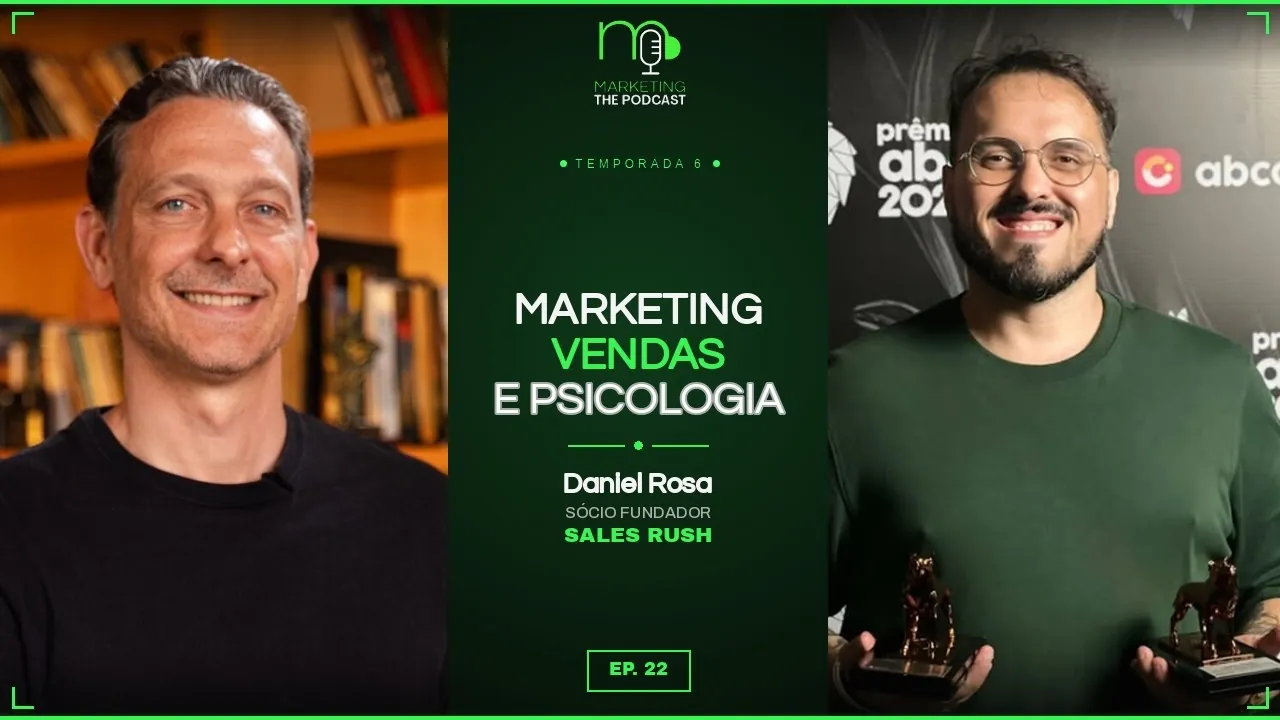
Daniel Rosa, co-founder of Sales Rush, presented the B2B sales delta framework during a conversation with Bruno Gimenes on Marketing - The Podcast. The approach argues that success in high-value enterprise negotiations depends on the combined execution of three pillars: marketing, sales processes, and psychology. In a market accelerated by digital tools and artificial intelligence, Rosa warns against ignoring the natural maturation cycle required for strategic sales.
With modern prospecting tools and platforms like LinkedIn, identifying the decision-maker has become far more accessible than in the past, when professionals relied entirely on events and relationship networks. The issue, according to Rosa, arises when direct access creates unrealistic expectations of closing multimillion-dollar contracts immediately. In the video above, Rosa explains how account-based marketing operations demand discipline when managing a narrow pool of high-ticket prospects, such as corporate sponsorship packages.
The mistake of rushing complex deals
For Rosa, the culture of instant gratification does not apply to consultative enterprise deals. Unlike direct-to-consumer e-commerce on platforms like Mercado Livre, where low-ticket purchases often occur on impulse, the corporate market involves governance, multiple stakeholders, and extended timelines.
Rosa highlights the misguided behavior of sales reps who try to artificially accelerate the sales cycle: "What I'm seeing now is that online prospecting and access tools can easily put you in touch with people and tell you, 'Hey, this is the decision-maker'—something we didn't have before when you relied on relationships and events, didn't have direct email, and LinkedIn wasn't as up to date. But then, as soon as reps get that access, they try to close a two- or three-million-dollar deal on the very first call. They think speed is their greatest asset, shaped by a culture where everything moves fast. And that's simply not true; it's false."
Marketing as reading behavior and context
Within the proposed framework, marketing represents an understanding of people, market trends, and the client's business ecosystem. Rosa emphasizes that sales professionals must develop the sensitivity to grasp consumer desires alongside the real challenges buyers face in areas such as point of sale or brand management.
For Rosa, selling requires acting as a genuine business partner who understands the operational context and baseline of the client. "Marketing brings back this focus on first looking at marketing through the lens of people. Marketing is consumers—people who like being in the mix, observing, and understanding others. If you don't like people, you won't be a good salesperson, period," he notes.
Sales as method and process discipline
The second point of the delta is sales structuring. While creativity and adaptability have their place, Rosa argues that predictable commercial results stem from the disciplined execution of structured methods and workflows.
Rosa summarizes the role of the sales pillar in daily operations: "Sales is the process side. Even I didn't fully realize it before, but now that I'm studying it deeper, sales is the process—you build a process and you work within that process. When you build that, you own the outcome."
Psychology and emotional intelligence in closing deals
The third element, psychology, is highlighted by Rosa as the decisive conversion factor. Even after mapping the ideal customer profile and executing every stage of the sales pipeline, reps are still dealing with human beings facing personal stress, workplace friction, and shifting emotions.
Rosa observes that many reps blame lead quality when facing a disengaged decision-maker instead of practicing active listening and empathy: "Psychology comes in through emotional intelligence—how I identify what's going on, how I build that connection, how I read the moment of the human being sitting across from me, and draw things out to understand them better. It's almost like therapy; a great salesperson is someone who genuinely enjoys listening to people and asking thoughtful questions."
According to Rosa, offering genuine attention and listening to prospects during difficult moments—rather than forcing a sales pitch—builds long-term partnerships. This multidisciplinary thesis, combining marketing insights, sales methodology, and human behavior, forms the foundation of the educational programs and mentorships Rosa leads alongside ESPM.