
AI Demands Cultural Depth and Fundamentals, Daniel Rosa Says
According to the Sales Rush co-founder, attempting to create with artificial intelligence without prior cultural grounding yields artificial results.
In a discussion on Marketing - The Podcast, Daniel Rosa analyzes the impact of artificial intelligence on the creative economy. He emphasizes the critical need for cultural depth, classical studies, and mastery of creative fundamentals before turning to digital tools.
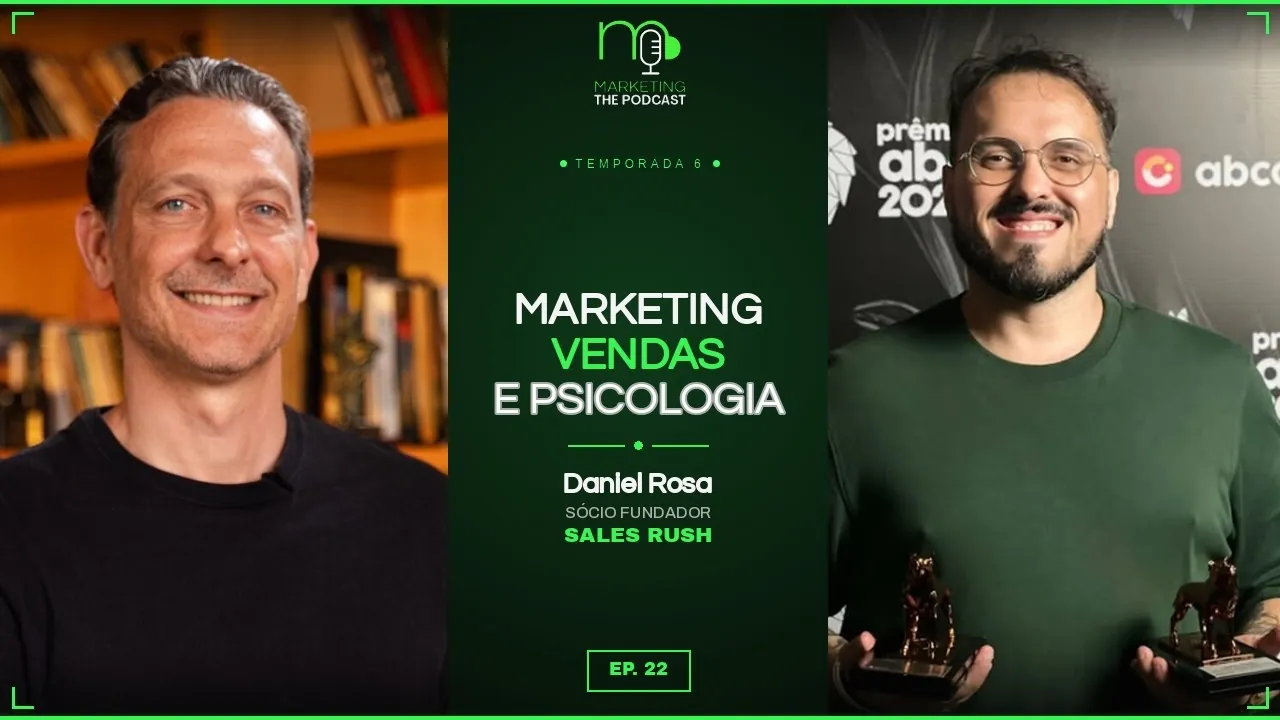
Daniel Rosa, founding partner at Sales Rush, analyzed the relationship between artificial intelligence and the need for cultural depth in advertising and content creation during a conversation with Bruno Gimenes on Marketing - The Podcast. The debate stemmed from observations of how audiences react on social media to content generated by or labeled as produced by automated tools.
Rosa explains that artificial intelligence is a valuable technical asset, but it becomes ineffective when used as a shortcut to bypass building cultural repertoire and studying conceptual fundamentals.
The illusion of shortcuts without fundamentals
Comparing career progression to belt ranks in Brazilian jiu-jitsu, Rosa argues that many professionals attempt to skip essential steps by chasing instant results through prompt commands. In his view, trying to mimic renowned creative styles without genuine lived experience leads to hollow output.
"People want to jump straight from white belt to black belt—like trying to hack Marcelo Serpa's style. Serpa is one of the greatest copywriters and art directors in Brazilian advertising history, with numerous Cannes Lions for campaigns like Havaianas and Volkswagen. Someone goes to an AI and types, 'Give me Marcelo Serpa's exact tone of voice.' But that person has never surfed, never cleaned a fish, never lived Marcelo's culture. Isn't that going to ring completely hollow?" Rosa asks.
Rosa emphasizes that lacking artistic and historical references compromises creative quality: "There are people who don't know and have never studied Bauhaus, who know nothing about it, so their work stalls and feels completely synthetic. That is the real risk."
The creative process before the prompt
Rosa advises marketing and creative teams to prioritize analog research and conceptual study before asking generative models for variations. Bruno noted that consultant Renato Ábido also highlighted on the show the importance of studying Bauhaus and the classic principle that superficial inputs yield equally weak outputs (garbage in, garbage out).
"Just get back to the fundamentals, study them, and only then use the tool. Sure, in your daily routine you'll use it for quick tasks, but when tackling a major project, build the foundation: open a book, study, grasp the concepts, write summaries by hand. Then take it to the AI to see its angle, and refine it again yourself," Rosa explains.
Cultural connection and the Manguebeat movement
To illustrate the synergy between technique and identity, Rosa points to the cultural impact of Manguebeat and the legacy of Chico Science, who blended traditional Brazilian music with electronic technology to pioneer a distinct movement.
"He rooted everything in culture, connecting technology and computers to artistic identity, and it became a movement. Where people get confused today is expecting the computer to create the movement for them. You have to know what you want to build first," Rosa asserts.
Rosa concludes that technology must serve human intent, cautioning that overreliance on prompts without intellectual substance erodes differentiation across the creative industry.