
Anthroposophic Mentoring & Leadership with Paulo Ruivo
How seven-year biographical cycles and organizational threefoldness transform corporate management and workplace well-being.
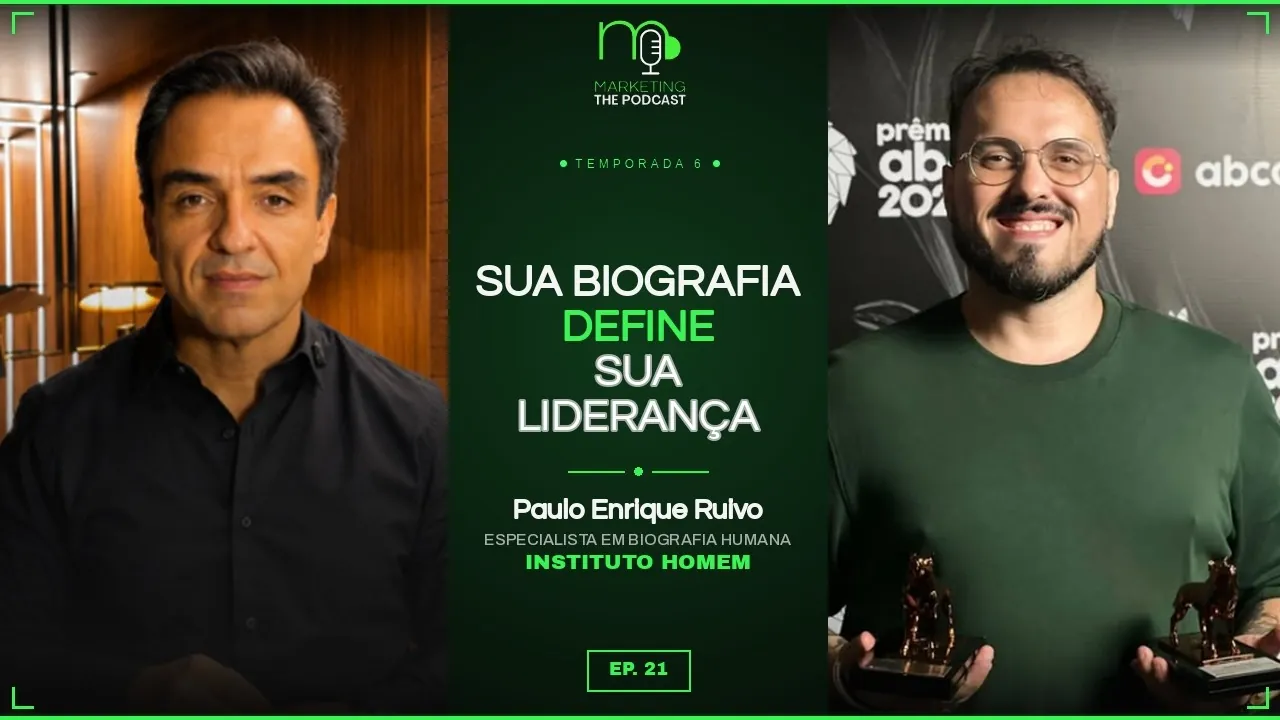
Paulo Ruivo, Humanization Director at Instituto Homem, breaks down the foundations of anthroposophy and human biographical cycles. In conversation with Bruno Gimenes, he discusses the intersection of self-awareness, leadership, and psychosocial risk management.
Paulo Ruivo, partner and Humanization Director at Instituto Homem, joined Bruno Gimenes on Marketing - The Podcast to discuss how human biography, seven-year developmental cycles, and anthroposophy shape corporate communication, executive leadership, and workplace health. The conversation ranges from the core tenets of self-awareness to the practical implementation of humanized organizational models under contemporary mental health demands.
In the video above, you can watch the complete interview, explore reflections on personal development, and discover practical examples drawn from clinical environments and executive mentoring.
Paulo Ruivo's Journey and Human Essence
Ruivo detailed his personal path and professional background, highlighting how fatherhood and daily routine shifts reshaped his practical worldview. He traced his evolution across multiple fields—including business administration, architecture, and psychoanalysis—culminating in his training in biographical counseling at the Anthroposophic center in Dornach, Switzerland. He also described his physical and mental transformation through disciplines like CrossFit and running, emphasizing that self-development does not mean an absence of flaws.
For Ruivo, confronting personal limitations is the essential first step toward any authentic public voice: "We strive for this perfection, reflecting something greater that was once here and set an example for us. I believe this is a genuine path to waking up something dormant within us while we are still alive."
Anthroposophy, Seven-Year Cycles, and the Human Biography
Founded by Rudolf Steiner through scientific inquiry and the legacy of Johann Wolfgang von Goethe, anthroposophy seeks to bridge empirical science with the spiritual and conscious dimension of humanity. Ruivo explained that human life unfolds in seven-year cycles, known as septenniums, spanning from birth to age 63, when an individual reaches a new phase of biographical maturity.
According to Ruivo, each phase brings transformative demands requiring detachment and heightened awareness: "Age 35 is a true turning point. Life extends an invitation—a symbolic call starting around 35 and intensifying at 37—to climb down from your high horse. If you don't climb down by 42, between 42 and 49 life comes along and kicks you right off it." He noted that resisting these natural cycles creates frustration, whereas understanding one's inner truth strengthens personal voice and presence.
The Search for Purpose, Relationship with Money, and Self-Love
Addressing personal finances and professional fulfillment, the conversation emphasized that money should be treated as an outcome and a vehicle for a higher purpose, rather than the ultimate career goal. Ruivo warned against seeking external emotional validation, explaining that authentic happiness depends on recognizing one's own vulnerabilities and shadow self.
He illustrated this perspective by sharing how he handled the financial setback of falling victim to a scam, choosing to examine his own blind spots rather than shifting blame: "When I am fully present, I can see my own shadow. That is where genuine self-love begins. I know there is a part of me that can become opportunistic, so I have to keep that part in check." For Ruivo, financial equilibrium stems from self-love and clarity regarding one's role in the world.
NR-1, Psychosocial Risks, and Humanizing Corporate Culture
The discussion addressed workplace mental health and the regulatory guidelines of Regulatory Standard No. 1 (NR-1) regarding psychosocial risks, set against rising employee leaves caused by burnout and emotional disorders. Ruivo detailed the model implemented across Instituto Homem's 23 locations, structured on decentralized principles of cultural freedom, legal equality, and economic fraternity.
Under this framework, the organization adopted a shared-wealth model where employees across all departments can purchase equity shares in new locations: "Every one of our employees—from receptionists to doctors, from HR to corporate staff—can become a partner and purchase a 1% to 5% stake. This brought our turnover rate to zero. No one wants to leave, because beyond receiving above-market compensation, which we prioritize, we also empower and educate them financially to invest." Ruivo maintains that companies must take active responsibility for educating their teams and safeguarding their vitality.
Anthroposophic Principles Applied to Leadership and Organizational Balance
To build a healthy organization, anthroposophy applies the principle of the threefold social organism, aligning thinking with founders and executive leadership, feeling with middle management, and willing/acting with operational teams. Ruivo stressed that clarity and transparency in executive leadership are essential for middle managers to lead with empathy and for frontline staff to execute with prudence.
He compared rhythmic work management to the act of breathing, emphasizing that non-stop demands without recovery periods degrade the corporate ecosystem: "If there is clarity in thinking, it fosters warmth in feeling. Leaders manage with cordiality, and teams act with prudence. Otherwise, you get overburdened directors who crush their teams and overdemand because of top-down pressure. Leaders must recognize where they stand." Ruivo concluded by advising executives to establish healthy boundaries between rigorous professional effort and essential recovery time.