
Berlin Marathon: Heat, Hydration, and Race Strategy
Coaches Marcos Paulo Reis and Camilo Alves share critical insights on aid station logistics and pacing in warm weather.
The Berlin Marathon demands careful attention to rising temperatures and on-course hydration. Running coaches break down aid station logistics and explain how to adjust pacing when the heat kicks in.
Despite its reputation as a flat, world-record course, the Berlin Marathon presents hidden challenges that can derail unprepared runners. Key among the race's critical variables are rising morning temperatures and uniquely structured hydration logistics.
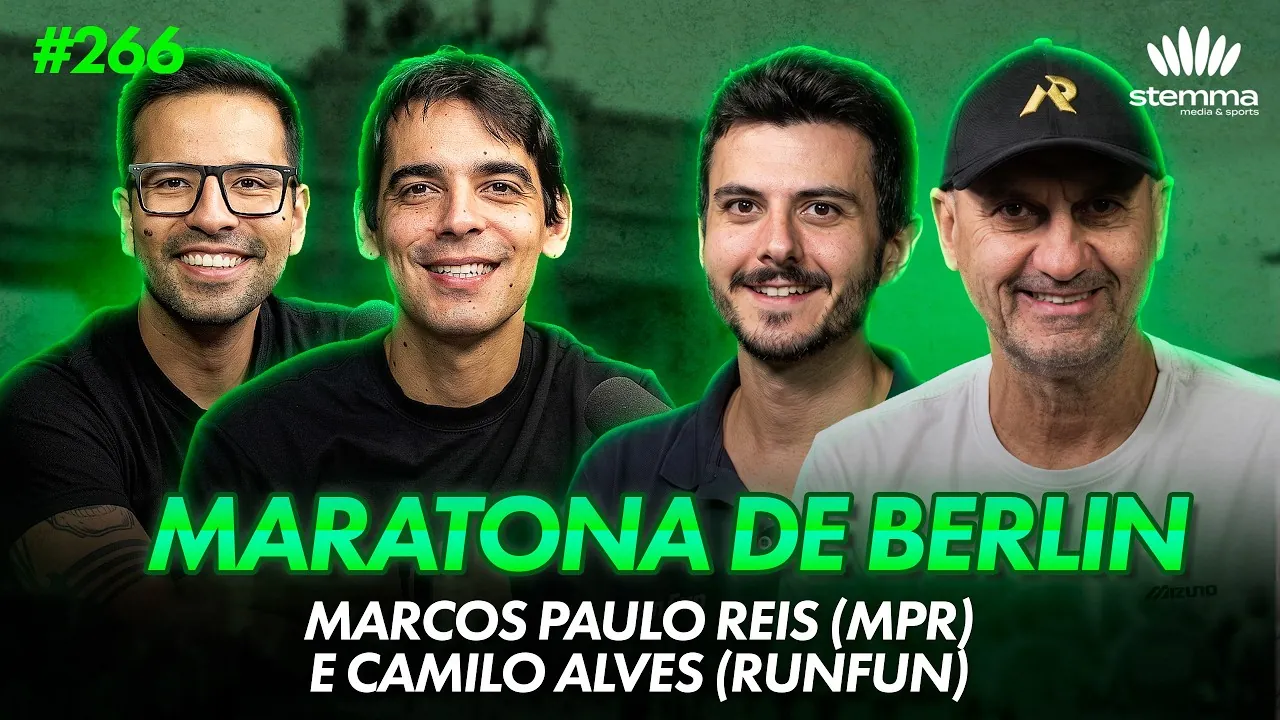
In a race analysis, running coaches Marcos Paulo Reis (founder of MPR Assessoria) and Camilo Alves (partner-director at RunFun) explored how the local weather and fueling setup demand high autonomy and quick thinking from every athlete.
The impact of heat and pacing adjustments
With start waves rolling out from 8:45 a.m., Berlin temperatures often climb during the race, reaching highs around 19 °C to 22 °C (66 °F to 72 °F) or more. For the coaches, the biggest mistake a runner can make is ignoring the thermometer and attempting to hold a pace dialed in for cold weather.
Marcos Paulo emphasizes that runners must take ownership of on-course decisions: when temperatures rise, stubborn adherence to goal pace almost always leads to a late-race collapse. His advice is to stay attuned to your body's signals and embrace a more conservative pace to avoid hitting the wall.
Aid stations: Rigid cups and right-side tables
Hydration logistics in Berlin feature specific quirks that catch many international runners off guard. Unlike major US races that provide flexible wax paper cups that are easy to pinch into a spout, Berlin uses semi-rigid clear plastic cups. Squeezing these cups causes them to crack, making it tricky to drink while running at high speeds.
Another critical factor is table placement: aid stations are positioned strictly on the right side of the street, using short clusters of tables rather than long, extended aid zones. This setup funnels runners into tight bottlenecks, causing scuffles for cups and creating slippery asphalt, especially around sticky sports drink zones.
Fueling strategy and using a soft flask
The first water station doesn't appear until km 5 (mile 3.1). Subsequent water stops are located at kilometers 12, 17.5, 22.5, 27.5, 32.5, 34.5, 38, and 40. The official sports drink, Maurten Drink Mix, is served at kilometers 9, 15, 20, 25, 30, and 36, along with Maurten gels.
To bridge the gap to the 5K mark and bypass chaotic early tables, the coaches recommend starting with a small disposable bottle or soft flask filled with water or a carbohydrate mix prescribed by your sports nutritionist, discarding it later along the course.
The final stretch and the Brandenburg Gate
Beyond watching your footing on neighborhood cobblestone patches and wet aid zones, Camilo Alves and Marcos Paulo highlight a classic visual trap: passing under the iconic Brandenburg Gate is not crossing the finish line. Runners still have 200 to 300 meters (about 650 to 1,000 feet) to go along the final straightaway before reaching the official timing mat.